
By Solar Tax Pros | April 2026 | U.S. Solar Industry & Renewable Energy
Your electric bill isn’t lying to you. That creeping number in the top right corner of your utility statement the one that seems to climb a little higher every single month reflects something much bigger than what’s happening in your neighborhood. It’s connected to a global energy system under serious strain, and the pressure is only building.
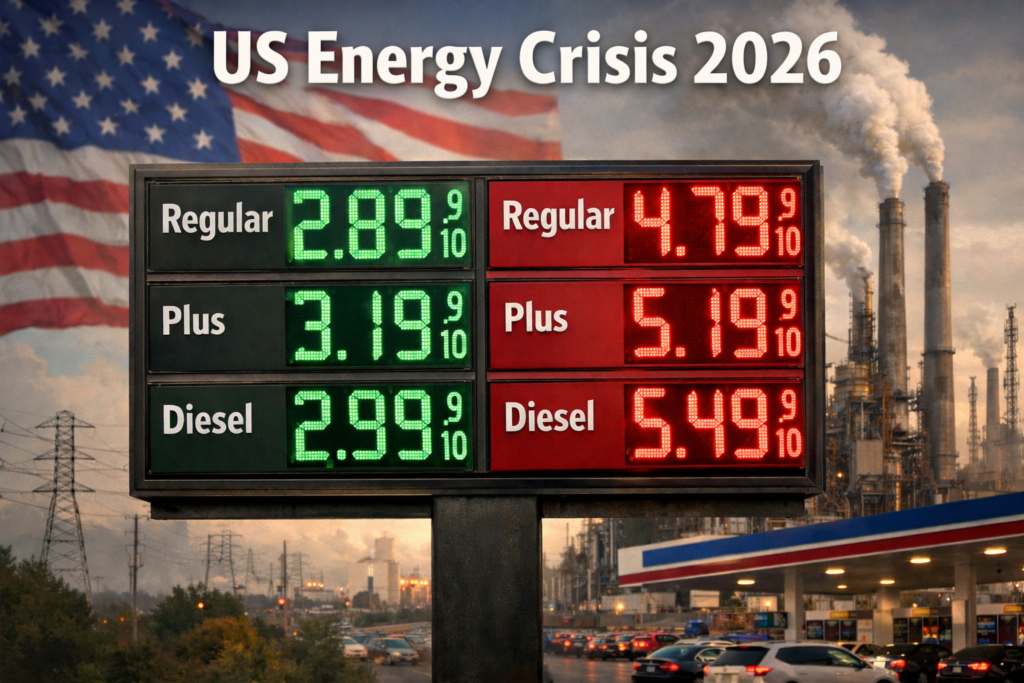
Right now, in April 2026, the United States is navigating one of the most complicated energy moments in recent memory. Oil prices spiked sharply after military conflict in the Middle East disrupted the Strait of Hormuz the narrow chokepoint through which roughly 20% of the world’s oil supply passes. The International Energy Agency called the resulting disruption the “largest supply disruption in the history of the global oil market.” Brent crude jumped more than 13% to around $80–82 per barrel by early March, with analysts warning of a breach past $100 per barrel if disruptions continued.
That kind of volatility doesn’t stay on trading floors. It rolls downhill into gas stations, heating bills, manufacturing costs, and eventually, your power bill. And here’s what most Americans don’t realize: your power bill was already going up before any of this started.
The Bill That Keeps Growing — Even When You Don’t Use More Power
Since 2010, average residential electricity prices in the United States have risen by nearly 30%. In 2025 alone, 39 of the 50 states saw real increases in residential electricity rates. The EIA projects national residential rates climbing to about 17.94 cents per kilowatt-hour in 2026 and in states like California, that number already exceeds 31 cents per kWh in many utility territories.
That’s not a typo. In some parts of Southern California, a home using 700 kWh a month a completely normal amount is paying close to $275 per month. Southern California Edison announced a 12.9% rate increase in 2026 on top of years of prior hikes. Con Edison in New York received approval for multi-year rate increases beginning in 2026. Utilities across the country are requesting rate increases totaling $71.2 billion through 2028.
What’s driving this? It’s not one thing it’s everything at once.
America’s electrical grid was largely built in the mid 20th century. Much of it is operating well beyond its intended lifespan. Utilities are spending billions to harden infrastructure against wildfires, extreme weather, and cybersecurity threats and every dollar of that spending gets passed directly to ratepayers. On top of that, the AI data center boom is reshaping electricity demand in ways the grid wasn’t designed to handle. Electricity demand is forecast to grow by 1% in 2026 and 3% in 2027, driven almost entirely by computing infrastructure. That growth keeps prices trending upward through the rest of the decade. And then there’s the geopolitical layer.
What’s Happening in the Middle East Is Not Staying in the Middle East
The Strait of Hormuz has long been described as strategically important for oil. That description barely scratches the surface. Roughly 20 million barrels per day of crude oil and oil products moved through the strait in 2025 along with a significant share of global liquefied natural gas trade. When military conflict in early 2026 effectively impaired commercial traffic through the strait, the shockwaves spread fast.
Natural gas and LNG prices jumped. Iran’s closure of the strait disrupted supply chains that run far beyond oil the strait also accounts for roughly 40% of the world’s helium supply, about 15% of global polyethylene capacity, and significant shares of fertilizer and aluminum. The World Economic Forum described the situation as “a structural shock to the world economy, delivered at a moment of geoeconomic fragility.”
For American consumers, the most direct impact is inflation. When energy input costs rise, everything becomes more expensive groceries, manufacturing, transportation, heating. Central banks grow cautious. Interest rate cuts get delayed. Household purchasing power erodes. This is what economists call a “stagflationary” environment: slow growth combined with sticky inflation.
The U.S. is not immune. In fact, Chatham House analysts note that American energy prices were already set to rise long before the Iran conflict escalated partly because domestic natural gas demand is tightening due to a 50% forecasted increase in LNG exports by 2027. As the U.S. exports more natural gas to energy-starved allies in Europe and Asia, the domestic market tightens, and prices climb. This is the environment you’re paying your electric bill inside of.
The Tax Credit Window That Already Closed and What It Means for You?
On July 4, 2025, President Trump signed the One Big Beautiful Bill into law. That single piece of legislation rewrote the solar incentive landscape in ways most homeowners still don’t fully understand.
The 30% residential solar tax credit Section 25D of the U.S. Tax Code expired on December 31, 2025. If you purchased and installed a solar system with cash or a loan before that date, you can still claim the credit when you file your 2025 taxes. But for homeowners going solar in 2026 with direct ownership, that federal credit is gone.
That’s a significant change. On a $25,000 system, the 30% credit was worth $7,500 a dollar-for-dollar reduction in federal tax liability, not just a deduction. That credit is now unavailable for homeowners who buy systems outright.
However this matters the story doesn’t end there.
Third-party owned solar systems (leases and Power Purchase Agreements, or PPAs) remain eligible for the commercial solar tax credit under Section 48E through the end of 2027. Under this structure, the installer or leasing company owns the system and claims the credit, passing the savings to homeowners through lower monthly payments. Commercial and utility scale solar has a separate timeline: systems that begin physical construction by July 4, 2026, or are placed in service by December 31, 2027, still qualify for the 30% ITC. This creates a decision point that’s actually more urgent now, not less.
Waiting doesn’t protect you from anything. It just means more months paying rates that rise while your solar opportunity window gets smaller. The financial math on solar doesn’t depend solely on the federal tax credit it depends on the gap between what you pay the utility and what it costs you to make your own power. And that gap is widening every month.
Why Countries With Solar Are Weathering This Crisis Better?
Here’s the thing about a geopolitical energy shock: it exposes which countries made smart long-term energy choices and which ones didn’t.
Countries that built out domestic solar and battery capacity over the past decade are now absorbing this shock better. NPR reported in March 2026 that Pakistan a country that has seen explosive growth in rooftop solar has more resilience in this crisis because its electricity sector isn’t fully dependent on imported natural gas. As energy analyst Kingsmill Bond of the think tank Ember put it. Once you’ve got your solar panel, there’s no cost for the sun. But once you’ve got your gas fire power station, you have to pay every day for the gas that you burn in it. With a stroke, this war has dramatically increased the power and the influence of those who want to go down the solar route. The same principle applies at the household level in America.
A homeowner with solar panels and battery storage isn’t watching crude oil charts with anxiety. They’re producing their own electricity from sunlight a resource that has never been blockaded, never been subject to a geopolitical tariff, and never had a shipping lane disrupted. Their cost of electricity is locked in for 25 to 30 years from the moment their system goes live.
Meanwhile, their neighbor is fully exposed to every rate increase, every fuel spike, and every grid investment cost that utilities pass along to customers.
Wood Mackenzie analysts noted in their 2026 energy outlook that the Middle East crisis could act as “a powerful catalyst for long-term system change,” accelerating structural shifts toward energy independence at both the national and household level. That structural shift is already happening and the households that move early capture the most benefit.
The Real Math on Going Solar in 2026
Strip away the incentive debate for a moment and look at the fundamental economics. Solar panels produce electricity for 25 to 30 years. The cost of producing that electricity is essentially fixed from the day of installation it’s the amortized cost of your system, which doesn’t change. The cost of buying electricity from your utility, on the other hand, has a documented history of rising 5–8% per year in many states, compounding over time.
A household paying $250 per month in electricity today, facing a conservative 5% annual rate increase, will spend roughly $120,000 on electricity over the next 20 years. A solar system sized to cover that same home’s usage financed over 10–15 years typically costs far less in monthly payments than that same electric bill. After the loan is paid off, the electricity is effectively free for the remaining life of the panels.
That’s not a sales pitch. That’s arithmetic.
And in 2026, with electricity rates elevated by geopolitical pressure, aging grid costs, and surging demand from data centers, the arithmetic has never been more favorable for solar. Battery storage adds another layer. When you store your solar production during the day and discharge it during peak evening hours — when grid electricity is most expensive — you maximize your savings and reduce your grid dependence to near zero. In states with time-of-use pricing, the difference between peak and off-peak rates can be as much as 5 to 8 times, meaning smart storage can pay for itself faster than most people expect.
State Incentives Fill the Federal Gap
The expiration of the federal residential credit doesn’t mean incentives have disappeared. It means you need to know where to look. States like New York, New Jersey, Illinois, California, Colorado, and Connecticut all maintain substantial solar and battery incentive programs at the state level. New York’s state tax credit offers up to 25% of system cost (capped at $5,000). California’s SGIP battery storage program offers rebates worth several thousand dollars in qualifying situations. Net metering policies in most states still allow solar homeowners to bank excess production as utility credits.
Understanding which incentives apply to your situation and how to structure your installation to maximize every available credit is exactly where professional guidance pays off. This is the point at which working with a firm that specializes in solar tax strategy genuinely changes your outcome.
Our partners Solar Tax Pros focuses on exactly this: helping American homeowners understand the real financial picture of going solar, navigate the current incentive landscape accurately, and make decisions grounded in real numbers not marketing claims. In a policy environment that changed dramatically in 2025, that kind of clarity has real dollar value.
The Strategic Window Is Right Now
Every major energy crisis in history has produced a policy and behavioral response. The 1973 OPEC embargo accelerated France’s nuclear program. The 1979 Iranian Revolution drove Japan’s aggressive energy efficiency push. The 2022 Ukraine invasion triggered Europe’s fastest renewable energy deployment on record.
The 2026 Middle East crisis is doing the same thing at a moment when solar technology is the cheapest it has ever been, battery storage is more accessible than ever, and grid electricity costs are the highest they have ever been.
For American homeowners, that convergence creates a window. Not a permanent window solar technology will keep improving, but so will grid rates. The question isn’t whether solar makes sense; the data on that is settled. The question is whether you capture the savings now or continue paying utility rates that will be higher next year than they are today.
The households that look back at 2026 with satisfaction won’t be the ones who waited for perfect certainty. They’ll be the ones who looked at a genuine energy crisis, ran the numbers honestly, and made a move that protected their family’s finances for three decades.
The sun isn’t under sanction. It doesn’t flow through the Strait of Hormuz. And it’s rising over your roof every single morning.
Solar Tax Pros helps U.S. homeowners and businesses navigate the real financial and tax dimensions of going solar. For a straightforward, no-pressure analysis of what solar could mean for your specific situation, visit solartaxpros.com